
My dog Luna taught me this lesson the hard way. One rainy morning in Denver, I grabbed my coffee, rushed out the door, and forgot her heartworm chew sitting right on the counter. Nothing bad happened that time, but it scared me enough to build a real system. That’s when I started testing routine planners, comparing calendars, apps, and plain paper lists, until I found what actually works for busy pet owners. This guide shares what I learned, so you can pick the best pet routine planner without the trial and error I went through.
What Is a Pet Routine Planner?
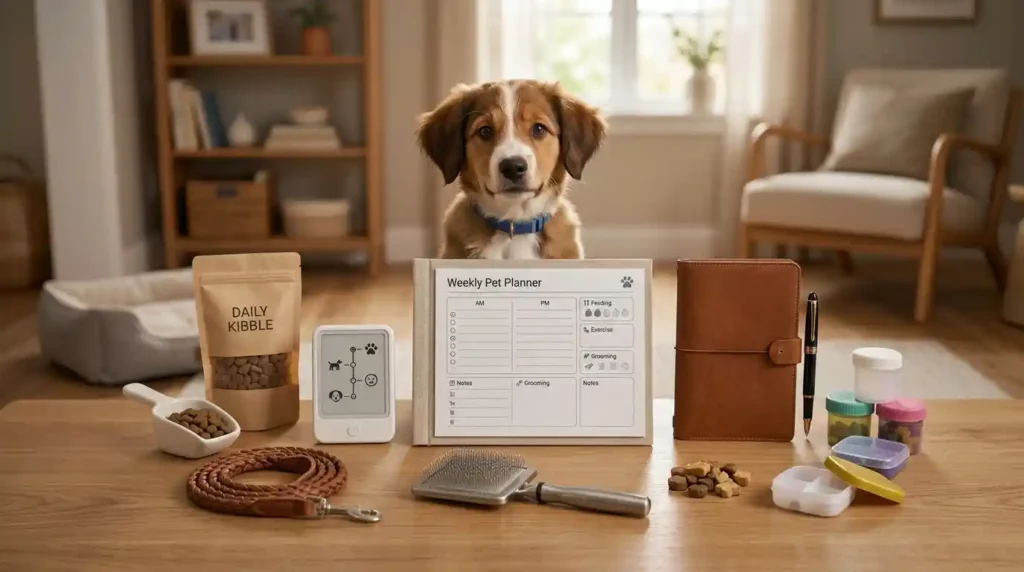
A pet routine planner is any tool that helps you organize the tasks your pet needs every day, week, or month. It can be an app, a wall calendar, a spreadsheet, or a notebook by the door. The format matters less than the habit it builds.
A good planner brings feeding times, walks, medication, grooming, and vet visits into one place. It should support your veterinarian’s advice, not replace it. Think of it as the assistant that remembers what your brain is too busy to hold onto.
What a Good Planner Can Track
- Meals and feeding times
- Water checks
- Walks and exercise
- Medication reminders
- Flea and tick prevention
- Grooming
- Nail trims
- Dental care
- Weight checks
- Training sessions
- Vet appointments
- Vaccination dates
- Health observations
- General pet-care notes
Planner vs Pet Health Calculator vs Pet Health App
People mix these up constantly, so let’s separate them clearly.
| Tool | Main Purpose | Example Use |
|---|---|---|
| Routine planner | Organizes tasks | “Give Luna her evening meal” |
| Pet health calculator | Estimates a metric | Calories or ideal weight |
| Health tracker | Records changes | Weight or symptoms over time |
| Veterinary software | Clinical care | Vet records and medical decisions |
A planner organizes your day. A pet health calculator estimates a number, like calories. A veterinarian interprets what that number actually means for your pet’s health. A good article, and a good planner, should never blur those three roles.
Why Pet Owners Need a Routine Planner
Modern pet care involves a surprising number of small, easy-to-forget tasks. Missing one occasionally is normal. Missing the important ones repeatedly is where trouble starts.
Reduce Forgotten Tasks
A planner with reminders helps with daily meals, exercise, medication, grooming, monthly parasite prevention, and vet appointments. Current AAHA guidance specifically recommends staying consistent with parasite prevention and setting reminders for recurring treatments. Consistency, not memory alone, is what actually protects your pet.
Make Multi-Pet Care Easier
If your house looks anything like mine, with one dog and a cat who acts like she owns the place, you know single-pet advice doesn’t always apply. Multi-pet households need to juggle:
- Two or more dogs
- Dogs and cats together
- Senior and young pets
- Pets with different medication schedules
A planner that separates each pet’s schedule saves you from mixing up Luna’s joint supplement with the cat’s flea prevention.
Create a Shared Household Routine
If more than one person cares for your pet, you’ve probably had this exact conversation: “Who fed the cat?” A good planner makes the answer visible instead of turning breakfast into a small investigation. Shared task lists with checkmarks solve this better than any group text ever will.
What Should the Best Pet Routine Planner Include?
This is the section I wish someone had written before I started comparing apps.
Daily Task Scheduling
Look for recurring schedules, custom times, daily, weekly, and monthly tasks, snooze options, completion tracking, and missed-task alerts. If a planner can’t repeat a task automatically, you’ll end up re-entering the same reminder every single day, and you’ll quit within a week.
Feeding and Water Tracking
A strong planner includes meal times, portion notes, treat tracking, water reminders, and support for multiple feeding schedules. It should never try to determine your pet’s exact diet for you. That decision belongs to your vet, based on your pet’s actual body condition and health history.
Exercise and Activity Tracking
Track walk duration, number of walks, play sessions, training, and both indoor and outdoor activity. The ASPCA notes that exercise needs vary based on factors like breed or breed mix, age, and health status, so there’s no single number that fits every dog. Use your dog exercise calculator as a starting estimate, then adjust based on how your pet actually responds.
Medication and Preventive-Care Reminders
This is the category that matters most to me personally, after that Denver morning with Luna. Look for medication name, schedule, dose notes, start and end date, reminder alerts, completion history, and space for vet instructions.
Here’s the safety point I can’t stress enough: the planner should record the schedule your veterinarian gave you. It should never calculate or adjust a dose on its own. A pet medication tracker is a logging tool, not a prescribing tool.
Grooming and Hygiene
Cover brushing, bathing, nail trimming, ear care, dental care, and professional grooming appointments. These tasks are easy to push off, and a planner keeps them from slipping into “someday.”
Veterinary Appointment Tracking
A useful planner stores the appointment date, clinic information, follow-up reminders, vaccine records, test records, questions you want to ask, and any attachments or notes. AAHA recommends routine veterinary care at least annually, with more frequent visits for senior pets and pets managing chronic conditions.
Best Pet Routine Planner Features to Compare
Rather than telling you one app is “the best,” I want to give you a framework to judge any planner yourself.
Reminder Quality
Ask whether the reminders are reliable, whether the times can be customized, whether recurring tasks repeat automatically, and whether completed tasks get logged for later reference.
Multi-Pet Support
Check for separate profiles, different schedules per pet, different medication lists, individual weight records, and shared household access.
Calendar and Notification Support
Look for phone notifications, calendar integration, a weekly overview, a daily checklist, and missed-task alerts. Some current pet-planning tools already offer recurring care reminders, household sharing, calendar syncing, and daily task views, so this bar is achievable, not a luxury feature.
Ease of Use
Here’s the honest truth from personal experience. A planner with forty impressive features is useless if you stop opening it after four days. Simplicity wins over complexity almost every time.
Pet Routine Planner Comparison Table
The right tool depends on your household. A solo dog owner might only need reminders and a calendar. A multi-pet household often needs shared tasks, medication logs, and health records working together.
| Planner Type | Best For | Strength | Limitation |
|---|---|---|---|
| Pet routine app | Busy pet owners | Automated reminders | May require subscription |
| Calendar app | Simple schedules | Familiar and flexible | Less pet-specific |
| Spreadsheet | Detailed tracking | Highly customizable | Manual setup |
| Paper planner | Offline users | Simple and private | No automatic alerts |
| Pet health app | Health-focused tracking | Records plus reminders | May be more complex |
| Household pet app | Families | Shared responsibilities | Feature availability varies |
How to Choose the Best Pet Routine Planner
Step 1: List Your Pet’s Recurring Tasks
Write down everything: feeding, water, walks, medication, parasite prevention, grooming, dental care, and vet appointments. Seeing it all on paper is often the wake-up call people need.
Step 2: Identify Your Biggest Problem
Are you forgetting medication? Missing grooming? Confusing feeding responsibilities with a partner or roommate? Losing track of vet dates? Struggling to manage multiple pets? Name the real problem before shopping for a solution.
Step 3: Choose the Simplest Tool That Solves It
This is what I call the minimum useful feature approach. Don’t buy a full health-tracking suite if all you need is a medication reminder.
Step 4: Test It for One Week
Use it daily for seven days. Notice whether it becomes part of your routine or whether you keep forgetting to open it.
Step 5: Review the Schedule With Your Veterinarian
This step matters most when your schedule includes medication, a special diet, a chronic condition, a weight-loss plan, or senior-pet monitoring. Your vet should sign off on the plan, not just your app.
How to Build a Daily Pet Routine
Morning Routine
Fresh water, breakfast, medication if prescribed, a short walk, a bathroom break, and a quick behavior check. This is the part of the day when I notice the most, the leash by the door, the food bowl clinking, that wet nose pushing against my hand until I move faster.
Afternoon Routine
A water check, exercise or play, training if you’re working on it, a feeding if scheduled, and a quick environment check.
Evening Routine
Dinner, a walk or play session, dental care, medication, a grooming task if it’s scheduled, and setting tomorrow’s reminders before you go to bed.
Weekly and Monthly Pet Care Planning
Daily tasks are only half the picture.
Weekly Tasks
A grooming check, a weight check when appropriate, bedding cleanup, toy inspection, food supply check, and a quick training review.
Monthly Tasks
Parasite-prevention schedule, medication supply check, a grooming appointment, nail care, and a review of activity patterns.
Annual or Periodic Tasks
A wellness exam, vaccination review, screening tests when recommended, a dental assessment, and a microchip or contact-information review. AAHA emphasizes that preventive plans should be adapted to species, age, lifestyle, and risk factors rather than treated as one identical schedule for every pet.
Pet Routine Planner by Life Stage
Puppy and Kitten Routine
Focus on frequent meals, training, socialization, the vaccination schedule, parasite prevention, growth monitoring, and plenty of sleep.
Adult Pet Routine
Focus on stable feeding, exercise, dental care, grooming, preventive care, and weight management. Your pet body condition score is a helpful check-in here, separate from just watching the number on a scale.
Senior Pet Routine
Focus on more frequent health monitoring, mobility changes, weight changes, medication, comfort, and veterinary follow-ups. AAHA notes that senior pets often need more frequent veterinary visits, with senior dogs and cats commonly recommended for exams every six months. If you’re tracking calorie needs at this stage, our guide on calories for senior pets is worth reviewing alongside your vet’s recommendations.
How a Pet Routine Planner Supports Preventive Care
Vaccination Tracking
A planner records dates and sets reminders. It should never suggest which vaccines your specific pet needs. That decision belongs to your veterinarian, based on your pet’s lifestyle and risk factors.
Parasite Prevention
Track your veterinarian’s recommended flea prevention, tick prevention, heartworm prevention, and any other parasite care on a consistent schedule.
Wellness Visits
Track the last exam, the next appointment, questions you want to ask, recommended tests, and follow-up dates.
Weight and Body Condition
Use your planner to notice trends over time, not to diagnose obesity yourself. If you want to log this properly, pair your planner with a tool built to track your pet’s weight and note any changes.
Dental Care
Track home dental habits and professional cleaning appointments side by side, since both matter for long-term health.
AAHA identifies wellness visits as an important opportunity for preventive care, including vaccinations, parasite prevention, screening, nutrition, and dental assessment.
Pet Routine Planner vs Veterinary Care
A routine planner is genuinely useful, but it has a boundary, and I think every article on this topic should say so clearly.
What the Planner Can Do
Remind, organize, record, track, display trends, and support communication with your vet.
What the Planner Cannot Do Reliably
Diagnose disease, replace a physical examination, confirm a medication is appropriate, interpret abnormal lab results, or decide whether an emergency is happening.
When to Contact a Veterinarian
Call your vet or an emergency clinic right away for sudden severe behavior changes, difficulty breathing, collapse, repeated vomiting, seizures, serious injury, suspected poisoning, or any other symptom that feels urgent. A planner should never be your final word on an emergency.
USA Expert Advice on Pet Routine Planning
Expert Reference: Mark Thompson, DVM, MBA, CCRP
Mark Thompson, DVM, MBA, CCRP, an AAHA veterinary expert, describes preventive care as the cornerstone of keeping pets healthy. In his own words, “Preventive care is the cornerstone of keeping pets healthy and happy.” I’d add my own take here: a routine planner is simply the tool that helps you actually follow through on the preventive care your vet already recommended. Knowing what to do and remembering to do it consistently are two very different challenges.
Additional Expert Insight
Bryan Clarke, DVM, DABVP, explains that wellness testing can detect problems that aren’t obvious from behavior or a physical exam alone. This reinforces something I try to remind readers of often: tracking behavior at home gives your vet useful information, but it never replaces professional testing.
Real-Life Example of Using a Pet Routine Planner
A Wednesday Morning in Chicago
Picture this composite scenario, based on the kind of mornings many pet owners describe to me.
- 7:00 a.m., breakfast
- 7:15 a.m., prescribed medication
- 7:30 a.m., walk
- 12:30 p.m., water check
- 5:30 p.m., exercise
- 7:00 p.m., dinner
- 9:00 p.m., dental-care reminder
It’s a cold Chicago morning. The leash hangs by the door. The dog refuses to move until breakfast appears in the bowl. The owner checks the phone with one hand and holds a coffee cup with the other, glancing at the planner before heading out.
Small Human Details Make Plans Work
Real routines include the small, human moments too, the way you talk to your pet before a walk. A friend of mine in New York says “চলো, হাঁটতে যাই” (let’s go for a walk) to her dog every evening, out of habit more than anything else. The language itself isn’t the point. The point is that the best routine is the one that actually fits how your household really behaves, not some rigid template pulled from an app store description.
Common Pet Routine Planning Mistakes
Making the Schedule Too Complicated
Too many reminders create notification fatigue, and fatigue leads to ignoring the app entirely.
Forgetting to Update the Planner
A routine needs updates when your pet ages, your work hours change, a medication ends, your pet gains or loses weight, or your veterinarian changes a recommendation.
Using Generic Advice for Every Pet
A puppy, a senior cat, a working dog, and an indoor adult cat simply don’t share the same needs. Resist the urge to copy a generic template.
Treating Calculator Results as Medical Advice
A calculator gives you an estimate. Your veterinarian interprets what that estimate actually means for your pet’s health.
Ignoring Household Responsibilities
Make it clear who completed each task when more than one person shares the caregiving. It saves arguments and prevents double-dosing on medication.
How to Make a Pet Routine Planner Actually Work
Start With Five Core Tasks
Begin with just feeding, water, exercise, medication or preventive care, and vet appointments. Add more only once these five stick.
Use Recurring Reminders
Set repeating tasks instead of re-entering the same reminder every morning. This one change saves the most time long term.
Keep Notes Short
A good note looks like “less active on Tuesday.” A less useful note is a five-paragraph diary entry about Tuesday’s weather and the neighbor’s Labrador. Short notes get read. Long ones get skipped.
Review the Planner Once a Week
A five-minute Sunday review catches problems before they become patterns.
Keep Emergency Information Separate
Store your vet’s contact, the nearest emergency clinic, your pet’s ID or microchip information, a current medication list, and any important medical notes somewhere easy to find fast.
Best Pet Routine Planner Feature Checklist
| Feature | Why It Matters | Priority |
|---|---|---|
| Recurring reminders | Prevents missed tasks | High |
| Multi-pet profiles | Separates schedules | High |
| Medication tracking | Helps follow prescribed routines | High |
| Vet reminders | Supports preventive care | High |
| Feeding logs | Tracks daily care | High |
| Exercise tracking | Shows activity patterns | Medium |
| Grooming reminders | Keeps maintenance organized | Medium |
| Weight tracking | Shows trends | Medium |
| Calendar sync | Connects with existing routines | Medium |
| Family sharing | Avoids duplicate tasks | Medium |
| Offline access | Useful without internet | Optional |
| Data export | Helps preserve records | Optional |
A planner doesn’t need every feature on this list. It needs the features that solve your actual problem, and nothing more.
Final Recommendation
After testing more apps, spreadsheets, and paper planners than I care to admit, here’s my honest take. The best pet routine planner isn’t the one with the most features. It’s the one you’ll still be using in six months. Start small, with just five core tasks. Pick a tool that fits how you actually live, not how a marketing page says you should live. Then loop your veterinarian in whenever medication, weight, or a chronic condition is part of the routine. A planner earns its place in your life by making your pet’s care steadier, not by adding one more thing to feel guilty about.
If you want to pair your routine with real numbers, check our pet health calculator, ideal weight for adult dogs guide, calorie calculator for pets, and veterinary calculator tools, then bring the results to your next wellness exam so your vet can confirm what they mean for your specific pet. For a deeper look at how preventive scheduling actually works, our preventive veterinary care guide is a solid next read, along with our breakdown on pet body condition score and cat weight calculator for multi-pet households.
FAQs About the Best Pet Routine Planner
What is the best pet routine planner for busy pet owners?
The best one is whichever tool you’ll actually open daily. For most busy owners, that’s an app with automatic recurring reminders and phone notifications, since it needs the least manual effort to maintain.
Can a pet routine planner track feeding and medication?
Yes. Most planners let you log meal times, portion notes, and a full medication schedule, including start and end dates and completion history.
Is a pet routine planner useful for multiple pets?
Very much so. Look for a planner with separate profiles for each pet, so schedules and medication lists don’t get mixed up.
Can a pet planner replace a veterinary health app?
No. A planner organizes tasks and reminders. A veterinary health app or your vet’s own records handle clinical decisions and medical history in more depth.
How often should I update my pet’s routine?
Update it whenever something changes, your pet’s age, your work schedule, a medication ending, a weight change, or new advice from your veterinarian.
Can I use a regular calendar as a pet routine planner?
Yes, especially for simple, single-pet households. It’s familiar and flexible, though less pet-specific than a dedicated app.
What should I track for a senior pet?
Focus on more frequent health monitoring, mobility changes, weight changes, medication schedules, comfort levels, and veterinary follow-ups.
Should a pet routine planner include veterinary appointments?
Yes. Appointment dates, clinic information, vaccine records, and follow-up reminders all belong in a complete planner.
Can a pet routine planner help with weight management?
It can help you notice trends over time. Actual weight-management decisions should still come from your veterinarian.
What features matter most in a pet routine app?
Reliable recurring reminders, multi-pet support, medication tracking, and vet appointment tracking consistently matter most, based on both the research and my own experience testing these tools.

Shakitul Alam is the Chief Executive Officer and Founder of Pet Calculator. He holds a degree in Computer Science and Information Technology from the University of Texas at Dallas, combining advanced algorithmic engineering with a lifelong passion for animal welfare and pet health care.
As a recognized pet care technology expert, Shakitul has spent years researching and developing responsive, vet-approved digital tools that make pet wellness data accessible to millions of dog and cat owners nationwide. Under his leadership, Pet Calculator adheres to the highest standards by pairing precise mathematical modeling with published veterinary science.