
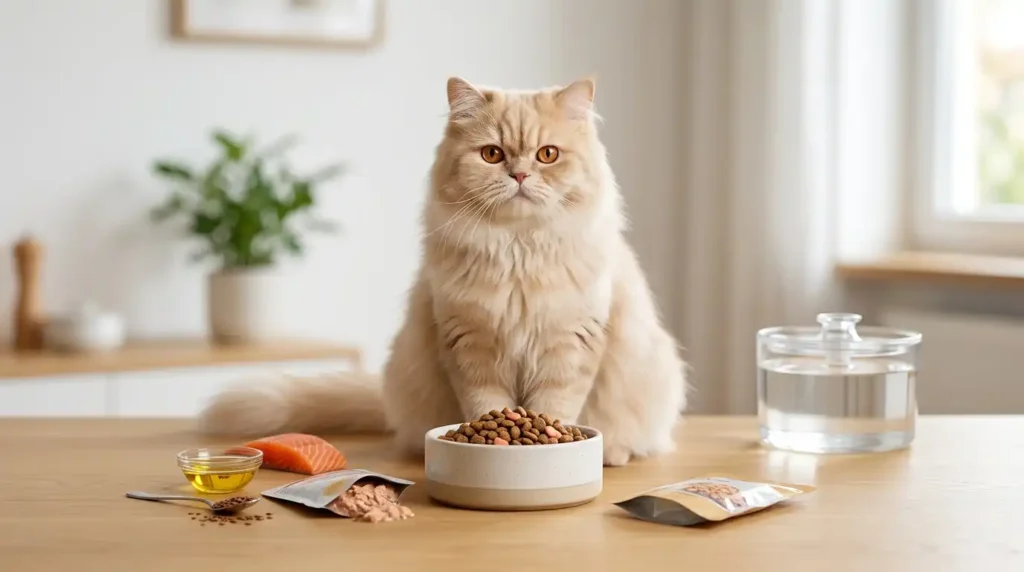
My Persian cat, Whiskers, has a trick. He sits by his bowl in our Denver kitchen every morning at 7 a.m. sharp, staring at me like I’ve personally wronged him by not feeding him five minutes earlier. He is fluffy. He is dramatic. And for the first two years I owned him, I genuinely couldn’t tell if he was gaining weight, because that coat hides everything. That’s really why I put together this Persian cat nutrition guide. Persian cats have specific needs around protein, hydration, weight, and daily feeding habits, and getting the basics right makes a bigger difference than any fancy supplement ever will.
Good nutrition supports a few clear goals for a Persian cat. It helps your cat keep a healthy body weight, build strong muscles, grow a soft and healthy coat, stay hydrated, digest food well, keep clean teeth, and age comfortably. A fluffy coat can hide weight gain or weight loss for months. That’s why body condition checks matter more than what you see on the surface.
Later in this guide, I’ll walk you through how a Persian cat nutrition calculator works, what it estimates, and why the numbers it gives you are a starting point, not a prescription. Nothing here replaces a conversation with your veterinarian, especially for kittens, senior cats, overweight cats, or cats with kidney, urinary, dental, or digestive issues.
What Should a Persian Cat Eat?
Persian cats need the same core nutrients as any other cat. What changes is how those nutrients get adjusted for body condition, age, activity, and health status. There’s no single “Persian cat diet.” There’s a solid nutritional foundation, and then fine-tuning for the individual cat in front of you.
High-Quality Animal Protein
Cats are obligate carnivores. That means their bodies are built to run on animal protein, not plant protein substitutes. Protein does three main jobs in your cat’s body. It maintains muscle. It repairs tissue. It supports normal everyday body function, from immune response to hormone production.
When you’re picking food, skip the trend chasing. Don’t pick a food because one ingredient sounds impressive on the bag. Look for a statement that the food is complete and balanced for your cat’s life stage. That single line tells you more than any marketing claim.
Essential Fats
Fat isn’t the enemy in a cat’s diet. It’s a concentrated energy source, and it plays a direct role in skin and coat health. Essential fatty acids, like omega-3 and omega-6, support the skin barrier and help keep that famous Persian coat soft rather than dry and brittle.
Vitamins and Minerals
A complete diet covers calcium, phosphorus, taurine, vitamin A, B vitamins, and a long list of other nutrients your cat needs in small but steady amounts. These aren’t optional extras. They’re built into any food that meets AAFCO’s complete and balanced standard.
Taurine Is Especially Important
Taurine deserves its own callout. Cats can’t make enough taurine on their own, and a taurine deficiency can lead to serious heart and eye problems over time. This is one area where I’d strongly discourage home experimentation. Don’t try to add human supplements or “boost” taurine yourself. Stick with a complete commercial diet that’s formulated specifically for cats, and let the manufacturer’s nutritionists handle the math.
Carbohydrates and Fiber
Cats don’t need a high-carbohydrate diet to thrive. Their bodies aren’t built around processing large amounts of grain or starch. That said, fiber isn’t the enemy either. A moderate amount of fiber can support digestive health and help move hairballs through the gut. The mistake I see a lot of Persian cat owners make is assuming “low carb” automatically means “special diet required.” For most healthy Persian cats, that’s simply not true.
Persian Cat Nutrition by Life Stage
Age changes calorie needs, meal frequency, and nutrition priorities. A Persian kitten isn’t a tiny adult cat. Feeding one like an adult, just in smaller amounts, misses the point of what a growing kitten actually needs.
Persian Kitten Nutrition
Kittens are growing fast, and that growth demands more calories per pound of body weight than an adult cat needs. A kitten-formulated complete food is built for that demand. Kittens also do better with more frequent, smaller meals rather than one or two large ones.
Here’s something I tell every new Persian kitten owner. Don’t let that fluffy baby coat fool you into overfeeding. A chubby-looking kitten can actually be right on track, or slightly behind, once you look past the fur. Monitor growth and body condition instead of guessing from appearance.
Adult Persian Cat Nutrition
Once your Persian reaches adulthood, the goal shifts to maintaining a lean body condition rather than supporting growth. That means measuring portions instead of eyeballing them, watching activity level, and keeping hydration steady day to day.
Senior Persian Cat Nutrition
Older Persian cats need closer monitoring, not because senior food is magic, but because their bodies change. Watch weight and muscle condition. Pay attention to appetite changes. Many vets recommend periodic screening for senior cats, since kidney and thyroid issues become more common with age. Adjust food based on actual health status, not just a birthday.
Persian Cat Nutrition for Indoor Cats
Most Persians live indoors, and that lower activity level often means lower calorie needs than an outdoor cat of the same size. Indoor life also raises weight-gain risk, since there’s less natural movement built into the day. Play and enrichment should be part of your feeding plan, not an afterthought. A few minutes of wand-toy chasing before meals can make a real difference over months.
How Many Calories Does a Persian Cat Need?
Calories should match the individual cat in front of you, not a generic breed number pulled off the internet.
What Changes a Persian Cat’s Calorie Needs?
A lot of factors shift the number up or down: age, current body weight, body condition, activity level, whether the cat is neutered or spayed, indoor versus outdoor lifestyle, growth stage, pregnancy or nursing status, and any medical conditions in play.
RER and Daily Energy Needs
Veterinary nutritionists often start with a concept called Resting Energy Requirement, or RER. It’s a formula that estimates the calories a cat burns just to maintain basic body function at rest. From there, vets apply a multiplier based on activity, life stage, and health status to estimate daily maintenance energy needs, which is usually higher than RER alone.
I want to be clear about something here. RER is a starting point for a conversation with your vet, not a fixed feeding prescription you can apply blindly. Two cats with the same RER can end up needing very different daily calorie totals once you factor in activity and health.
Why Breed Alone Cannot Set Calorie Needs
This is worth repeating because it trips up a lot of owners. Two Persian cats can have completely different calorie needs. A 4-kilogram sedentary indoor cat may need noticeably fewer calories than a larger, more active Persian. Health conditions like hyperthyroidism or kidney disease can also change requirements significantly. Breed tells you almost nothing about calories on its own.
Persian Cat Nutrition Calculator
This is where a lot of readers land looking for a practical answer, so let’s get specific.
Inputs for a Persian Cat Nutrition Calculator
A useful calculator asks for the details that actually move the number: age, current weight, body condition score, activity level, whether your cat is neutered or spayed, indoor or outdoor lifestyle, pregnancy or lactation status, current food, and calories per serving of that food.
Calculator Results
Plug those details in, and a good tool should give you a full picture rather than just one number. That typically includes an estimated daily calorie range, an estimated daily food amount, how many meals to split that across, calories per meal, a wet-food portion estimate, a dry-food portion estimate, and a mixed-feeding breakdown if you use both.
Important Calculator Warning
Here’s the part I never skip when I talk to other Persian cat owners. Calculator results are estimates, not medical advice. Body condition and weight trends over weeks matter more than any single number a tool spits out. If your cat has a medical condition, that estimate may not apply at all, and you’ll need a veterinary nutrition plan instead. Never use a calculator to replace actual veterinary treatment.
If you want to go deeper on the math side, our Most Accurate Calorie Calculator for Pets walks through the same RER-based approach in more detail, and our Best Veterinary Calorie Calculator compares a few different calculation methods side by side.
Persian Cat Food Guide: Wet vs Dry vs Mixed Feeding
There’s more than one workable feeding style for a Persian cat. What matters most is nutritional completeness, controlled portions, and enough water intake, regardless of which format you choose.
| Feeding Style | Main Benefit | Watch Out For |
|---|---|---|
| Wet food | High moisture, supports hydration | Spoils faster once opened, needs refrigeration |
| Dry food | Convenient, easy to measure, calorie-dense | Easy to overfeed without a scale or cup |
| Mixed feeding | Combines moisture and convenience | Requires counting calories across both foods |
Wet Food for Persian Cats
Wet food carries a lot of moisture, which helps push up your cat’s total water intake without them having to drink more from the bowl. It can also help with meal volume, since wet food is less calorie-dense per gram, and it’s genuinely easy to portion with a kitchen scale.
Dry Food for Persian Cats
Dry food is convenient and easy to measure by cup or gram. It’s also more calorie-dense than wet food, which means small measuring mistakes add up faster. Portioned carefully, it can absolutely be part of a healthy Persian cat’s diet.
Mixed Feeding
Mixed feeding combines wet and dry food, which a lot of Persian cat owners, myself included, actually prefer. The catch is that you have to count calories across both foods together. A common mistake is simply adding wet food on top of the usual dry-food amount, which quietly pushes total calories way past what the cat actually needs.
How to Read a Cat Food Label
A cat food label tells you almost everything you need to know if you know where to look. Check for the complete and balanced statement, confirm the life-stage suitability matches your cat, and look at calorie information, protein, fat, fiber, and moisture percentages. Then check the feeding directions, and treat them as a starting range rather than a strict rule.
Persian Cat Feeding Schedule
A predictable routine makes feeding easier for both you and your cat. Whiskers has figured out our schedule so well he starts pacing near his bowl about ten minutes before feeding time.
How Often Should Persian Cats Eat?
Kittens generally need more frequent, smaller meals throughout the day. Adult cats often do well on two to three scheduled meals. Some cats do best with their daily portion divided into several smaller feedings rather than one or two big ones, especially if they tend to gulp their food.
Morning Feeding Routine
A solid morning routine covers fresh water, a measured portion of food, and a quick appetite check. If your cat is eating wet food, remove any uneaten portion after a reasonable window so it doesn’t spoil in the bowl.
Evening Feeding Routine
In the evening, do a portion check, refresh the water bowl, and take a moment to notice body language and behavior. Small changes show up here before they show up anywhere else.
Automatic Feeders
Automatic feeders are genuinely useful for keeping meals measured and consistent, especially if your schedule is unpredictable. They need regular cleaning to stay sanitary. What they shouldn’t become is an excuse to stop paying attention. A feeder can dispense food on schedule, but it can’t tell you your cat skipped breakfast three days in a row.
Persian Cat Nutrition and Hydration
Persian cats need fresh water every single day, just like any other cat. This part of the guide gets overlooked more than it should.
Why Hydration Matters
Water supports basically every system in the body. It helps maintain healthy urinary function, supports digestion, and helps regulate body temperature. For a breed that can be prone to urinary issues, hydration isn’t a minor detail.
Ways to Encourage Water Intake
A few small changes go a long way. Set up multiple water stations around the house. Keep the water genuinely fresh, not just topped off. A water fountain encourages some cats to drink more than a still bowl does. Wet food adds moisture directly into meals. Keep bowls clean, and place water away from the litter box, since a lot of cats simply won’t drink near it.
Signs a Cat May Need Veterinary Attention
Watch for a sudden increase or decrease in drinking, a major change in urination habits, repeated vomiting, lethargy, or appetite changes. I want to be careful here. These signs aren’t a diagnosis on their own. But if they’re persistent or severe, they need a vet visit, not a wait-and-see approach.
Persian Cat Nutrition for Healthy Weight
This is the section I wish someone had handed me two years ago. Persian cats are genuinely hard to visually assess because that long, dense coat hides changes in body shape that would be obvious on a short-haired cat.
Use Body Condition Score
Body condition scoring is a hands-on method, not a visual one. Feel along the ribs rather than trusting your eyes. Check the waist from above and the abdominal shape from the side. Your vet can walk you through a standard body-condition scoring system in about two minutes at your next visit.
How to Tell if a Persian Cat May Be Overweight
A few signs to watch for: ribs that are hard to feel under a layer of fat, reduced waist definition, reduced mobility, less interest in play, and a gradual, steady weight increase over weeks or months.
How to Tell if a Persian Cat May Be Underweight
On the other end, watch for prominent bones, reduced muscle mass, poor overall body condition, unexplained weight loss, and a drop in appetite.
Weighing Your Persian Cat
Use the same scale every time. Weigh at roughly the same time of day. What actually matters is the trend over weeks, not any single reading. A pet scale at home is a small investment that pays off in early detection. Our Best Cat Weight Calculator and Cat Weight Tracker can help you log those numbers and spot a trend before it becomes a problem.
Persian Cat Nutrition and Hairball Management
That long Persian coat is gorgeous, and it’s also a lot of daily maintenance, both for you and for your cat’s digestive system.
Why Persian Cats Get Hairballs
Long hair plus regular self-grooming means a lot of swallowed fur over time. It’s simply part of owning a long-haired breed.
Nutrition and Hairball Support
Adequate hydration, appropriate fiber when your vet recommends it, and generally complete nutrition all support normal digestion and help fur move through the gut instead of building up.
Grooming Still Matters
Nutrition can’t replace brushing, full stop. Regular grooming reduces how much loose fur your cat swallows in the first place, which does more for hairball prevention than any food change. And one important caution. Severe or repeated vomiting shouldn’t automatically get blamed on hairballs. That pattern deserves a vet visit to rule out other causes.
Persian Cat Nutrition for Skin and Coat Health
A beautiful Persian coat isn’t built by one magic ingredient or one premium can of food. It’s the result of several things working together over time.
Protein and Coat Maintenance
Coat is largely made of protein, so adequate high-quality protein intake directly supports healthy hair growth and strength.
Essential Fatty Acids
Omega fatty acids support the skin’s natural barrier, which helps keep the coat soft and reduces flakiness and dryness.
Adequate Hydration
Dehydration shows up in skin and coat quality before it shows up almost anywhere else. Consistent water intake supports skin elasticity and coat shine.
Balanced Micronutrients
Zinc, certain B vitamins, and other trace nutrients all play smaller but real roles in coat health. This is another reason a complete and balanced commercial diet beats a patchwork of home additions.
When Coat Changes Need a Vet Visit
Sudden hair loss, excessive scratching, visible skin lesions, a coat that mats no matter how often you brush, or a major shift in grooming behavior are all reasons to call your vet rather than switch foods and wait it out.
Persian Cat Nutrition and Dental Health
Food is only one piece of the dental care puzzle, and I think this gets misunderstood more than almost any other topic on this list.
Why Dental Care Matters
Plaque and tartar build up over time, which can lead to gum disease and real oral discomfort for your cat. Left unmanaged, it affects eating, mood, and long-term health.
Does Dry Food Clean a Cat’s Teeth?
Here’s a claim I’d push back on directly. Ordinary dry kibble does not automatically clean a cat’s teeth just by being crunchy. Dental-specific diets and dental products are formulated differently from standard kibble, with texture and shape designed to reduce plaque. Even with the right food, veterinary dental care may still be needed.
Signs of Oral Problems
Watch for bad breath, drooling, difficulty eating, dropping food while chewing, and reduced appetite. Any of these warrant a dental check.
Foods Persian Cats Should Avoid
This section is about safety, plain and simple.
Toxic or Dangerous Foods
Keep chocolate, onions, garlic, alcohol, caffeinated products, and anything containing xylitol completely away from your cat. These aren’t “in moderation” foods. They’re off the list entirely.
Foods That Can Cause Problems
Excessively fatty foods, cooked or raw bones, raw foods with food-safety risks, and highly seasoned human food can all cause digestive upset or worse, even if they’re not classified as toxic.
Why Human Food Can Disrupt a Cat’s Diet
Table scraps add extra calories your cat doesn’t need, throw off the balance of a carefully formulated diet, cause digestive upset, and sometimes carry hidden ingredients like excess sodium or garlic powder that aren’t obvious from a glance.
Persian Cat Nutrition for Common Health Concerns
I want to be careful with this section. It’s not a diagnosis guide. It’s about knowing when nutrition needs professional adjustment.
Overweight Persian Cats
Weight management comes down to portion control, calorie density, activity, and slow, supervised weight reduction. Rapid weight loss in cats can actually be dangerous, so this is a “slow and steady” process under veterinary guidance.
Urinary Health
Hydration and an appropriate diet both play a supporting role in urinary health. If you notice urinary symptoms like straining, frequent trips to the litter box, or blood in the urine, that’s a same-day vet visit, not a wait-and-watch situation.
Kidney Disease
Diet often needs to change after a kidney disease diagnosis, and that change should come from veterinary nutrition advice, not a general internet recommendation. Please don’t put a healthy Persian cat on a kidney diet just because the breed has a reputation for kidney issues. That reputation doesn’t apply to every individual cat.
Digestive Problems
Vomiting, diarrhea, constipation, and appetite changes can all have nutritional roots, but they can also point to something unrelated to food entirely. Persistent symptoms deserve a vet visit.
Food Allergies and Intolerances
Skip the casual elimination diet you saw in a Facebook group. True food allergy diagnosis in cats is a structured process, and it works best with veterinary guidance rather than trial and error at home.
USA Expert Advice on Persian Cat Nutrition
Dr. Debra Zoran, Veterinary Nutrition Perspective
Dr. Debra Zoran, DVM, MS, DACVIM, is a board-certified veterinary internal medicine specialist with a strong background in feline nutrition. Her broader body of published feline nutrition guidance reinforces a theme that runs through this entire article. Cats have specific nutritional needs tied to their biology as obligate carnivores, and individual health conditions can and should change dietary recommendations from cat to cat. I want to be transparent here rather than invent a Persian-specific quote that doesn’t exist. The core principle from her work, that nutrition needs to be individualized, applies directly to Persian cats even without a breed-specific soundbite.
AAHA Guidance on Healthy Weight
The American Animal Hospital Association emphasizes hands-on body-condition assessment over visual judgment, which matters even more for a long-haired breed like the Persian. AAHA frames weight management as part of preventive healthcare, not a cosmetic concern, which lines up with everything in the healthy weight section above.
Expert Principle to Emphasize
Here’s the principle I’d want every Persian cat owner in New York, Denver, or anywhere else to walk away with. A healthy Persian cat should be judged by body condition, muscle tone, behavior, appetite, and overall health, not by how fluffy the coat looks. Fluff hides a lot. Don’t let it fool you.
Real-Life Persian Cat Nutrition Example
Meet Milo in Chicago
Milo is a 4-year-old neutered male Persian living indoors in Chicago with moderate activity. He eats a mix of wet and dry food. His owner noticed something small but telling. Milo started feeling heavier when picked up, even though his coat looked exactly the same as always.
The Owner’s Morning Routine
Milo’s day starts at 7:00 a.m. with fresh water, a measured breakfast, a quick brushing session, and a short play period with a wand toy. Weight gets recorded once a week on the same kitchen scale.
The Nutrition Adjustment
Once Milo’s owner noticed the weight change, she reviewed his current calorie intake, checked the food labels for both his wet and dry food, and compared portion size against calorie density. She started tracking weight and body condition weekly and brought the notes to her next vet visit for a proper discussion. That last step matters. A food diary is only useful if you actually act on what it shows you.
A Small Local Touch
Even a fluffy, well-fed Persian will still demand breakfast like it’s the first meal he’s ever had. My mother-in-law, who’s Bengali, has a phrase she uses every morning with her own cat that always makes me laugh: “আহা, আজ আবার খাবার চাই!” which roughly means “Ah, asking for food again!” Every Persian cat owner I know has some version of that same morning ritual.
Persian Cat Nutrition Tracking Table
A food diary is often more useful than guessing. Record what your cat actually eats for several days, then compare that intake against weight and body-condition changes over the following weeks.
| Day | Food | Amount | Calories | Water | Notes |
|---|---|---|---|---|---|
| Monday | Wet food | Custom | Custom | Good | Normal appetite |
| Tuesday | Dry food | Custom | Custom | Good | Active |
| Wednesday | Wet + dry | Custom | Custom | Moderate | Less play |
| Thursday | Wet food | Custom | Custom | Good | Normal |
| Friday | Wet + dry | Custom | Custom | Good | Weight tracked |
Fill in the “Custom” columns with your own cat’s actual numbers. Our Cat Food Calorie Calculator can help you convert cups or cans into a calorie total for this table.
Common Persian Cat Nutrition Mistakes
Feeding Based Only on the Package’s Maximum Amount
Feeding guides on the bag are starting points, not personalized instructions. Individual needs vary a lot from cat to cat.
Ignoring Calories in Treats
Treats count toward your cat’s total daily calories, even the tiny ones. They add up faster than most owners expect.
Free-Feeding Without Monitoring Weight
Some cats naturally regulate their own intake and do fine with food left out all day. Plenty of others don’t, and free-feeding turns into slow, steady weight gain without anyone noticing until it’s significant.
Changing Food Too Quickly
A sudden food switch is one of the fastest ways to trigger digestive upset. Gradual transitions over seven to ten days are much easier on the gut.
Choosing Food Because of Marketing Alone
Words like “premium,” “natural,” or “holistic” on a bag don’t replace actually checking the nutritional adequacy statement and ingredient quality.
Assuming Expensive Food Is Automatically Better
Price doesn’t equal nutritional completeness. Focus on whether the food is complete and suited to your individual cat, not the number on the price tag.
Treating Supplements as Essential
Supplements should have a clear, specific reason for being added, ideally one your vet has recommended. Some supplements can actually cause harm in excess, so more isn’t automatically better.
How to Choose a Persian Cat Food
Check for Complete and Balanced Nutrition
Look for the AAFCO statement confirming the food meets complete and balanced standards for your cat’s life stage.
Match the Food to Life Stage
Kitten, adult, and senior formulas aren’t interchangeable. Match the food to where your cat actually is in life.
Consider Calorie Density
Some foods pack a lot more calories into a small volume than others. That matters a lot for portion control, especially with dry food.
Consider Moisture
Higher-moisture foods support hydration more directly, which can matter for cats prone to urinary issues.
Consider Individual Health Needs
Weight, activity, and any existing health conditions should all factor into your final choice, not just breed.
Ask Your Veterinarian When Health Issues Are Present
If your cat has a diagnosed condition, loop your vet in on food choice specifically. Generic guidance takes a back seat to a personalized medical plan.
Best Tools for Managing Persian Cat Nutrition
Persian Cat Nutrition Calculator
Our Persian Cat Nutrition Calculator estimates calorie needs, converts those calories into real portion sizes, and lets you compare a few feeding scenarios side by side.
Cat Weight Tracker
The Cat Weight Tracker logs weekly or monthly weight entries, builds a trend chart automatically, and gives you a place to jot down body-condition notes alongside the numbers.
Cat Food Calorie Calculator
The Cat Food Calorie Calculator breaks down calories per can, per cup, and per gram, which makes label comparisons much faster.
Pet Wellness Calculator
The Best Pet Wellness Calculator combines weight, activity, age, and general wellness data into one overall picture.
Pet Medication Tracker
If your Persian is on ongoing medication, the Pet Medication Tracker keeps dosing and timing organized in one place.
Pet Health Record Tool
The Pet Health Record Tool is a good home for vaccine records, vet visit notes, lab results, and diet history all in one spot, which makes future vet visits a lot faster.
Final Recommendation
If you take one thing from this entire Persian cat nutrition guide, let it be this. Stop trying to find “the one best food” for Persian cats, because it doesn’t exist. What exists is a complete and balanced diet, matched to your cat’s life stage, adjusted for body condition and activity, and checked regularly against real weight trends rather than how fluffy the coat looks.
In my own experience with Whiskers, the single biggest change wasn’t switching food brands. It was starting to actually weigh his portions and track his weight weekly instead of guessing. That habit alone caught a slow weight gain months before I would have noticed it just by looking at him. Use the calculator as your starting point, use the tracking table to stay honest about what your cat actually eats, and bring your vet into the conversation whenever something changes. That combination will do more for your Persian’s health than any single ingredient or supplement ever could.
Persian Cat Nutrition Guide FAQs
What is the best food for a Persian cat?
There’s no single best food. Look for a complete and balanced diet matched to your cat’s life stage, then adjust based on body condition and any health needs.
How many times a day should a Persian cat eat?
Most adult Persians do well with two to three scheduled meals a day. Kittens typically need more frequent, smaller meals.
How many calories does a Persian cat need?
It depends on weight, age, activity, and health status. A nutrition calculator can give you a starting estimate, and your vet can refine it from there.
Should Persian cats eat wet or dry food?
Both can work well. Wet food supports hydration, dry food is convenient and calorie-dense, and many owners use a mix of both.
Do Persian cats need special food?
Not automatically. Most healthy Persian cats do fine on a quality complete and balanced diet. Special diets are typically only needed for diagnosed medical conditions.
How can I help my Persian cat maintain a healthy weight?
Measure portions, track weight weekly, count treat calories, and add short daily play sessions to increase activity.
How much water should a Persian cat drink?
It varies by cat, diet, and climate. What matters more is noticing sudden increases or decreases in drinking, which can signal a health issue.
Can Persian cats eat human food?
Some plain, cat-safe foods are fine occasionally, but many human foods are unbalanced or outright toxic. When in doubt, skip it.
Are Persian cats prone to obesity?
Their lower activity level and thick coat, which hides weight gain, can both contribute to a higher obesity risk if intake isn’t monitored.
Does Persian cat food help with hairballs?
Diet can support digestion, but regular grooming does more to prevent hairballs than any food change alone.
Should Persian kittens eat adult cat food?
No. Kittens need a kitten-formulated diet built for their higher growth demands, not a smaller portion of adult food.
When should I ask a vet about my Persian cat’s diet?
Any time you notice a weight change, appetite change, digestive issue, or a diagnosed health condition, bring your vet into the food conversation.

Shakitul Alam is the Chief Executive Officer and Founder of Pet Calculator. He holds a degree in Computer Science and Information Technology from the University of Texas at Dallas, combining advanced algorithmic engineering with a lifelong passion for animal welfare and pet health care.
As a recognized pet care technology expert, Shakitul has spent years researching and developing responsive, vet-approved digital tools that make pet wellness data accessible to millions of dog and cat owners nationwide. Under his leadership, Pet Calculator adheres to the highest standards by pairing precise mathematical modeling with published veterinary science.