
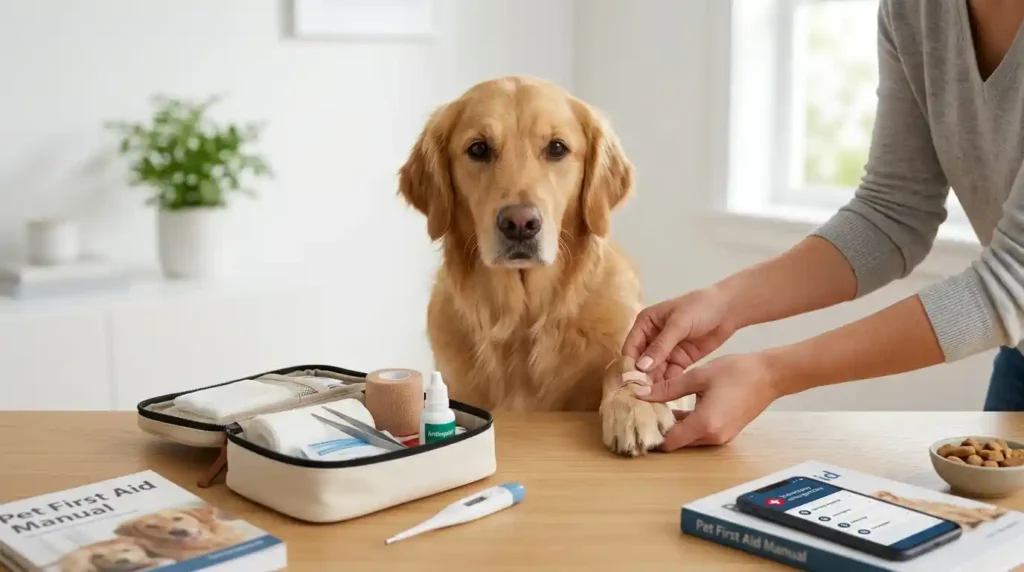
My dog Bailey once stepped on a piece of broken glass in our backyard in Denver at 9:30 p.m., and I still remember standing in the kitchen with a bleeding paw in one hand and my phone in the other, trying to remember anything useful. That night taught me that pet first aid basics aren’t something you want to learn for the first time during an actual emergency. Pet emergencies rarely happen at a convenient hour. Your dog suddenly starts limping, or your cat knocks something off the counter and starts acting strange, and suddenly you’re the one in charge for the next five minutes.
Here’s the most important thing to understand before we go further. Pet first aid is short-term help while you get your animal to professional veterinary care. It is not a replacement for a veterinarian. Current AVMA guidance is direct about this. First aid isn’t a substitute for veterinary treatment, and calling ahead lets the clinic prepare for your pet’s arrival before you walk through the door.
This guide covers what to do, and just as importantly, what not to do, across the most common pet emergencies. Along the way, I’ll walk through a first aid kit checklist, an emergency contact card, and a simple incident tracker you can actually use. Fair warning, “stay calm” turns out to be the hardest item on any checklist once your own pet is the one who looks scared.
What Is Pet First Aid?
Pet first aid is about protecting the animal, limiting further harm, and getting veterinary help as quickly as possible. It’s a bridge, not a destination.
What Pet First Aid Can Do
First aid has real, practical limits, and that’s actually a good thing to know upfront. It can help control external bleeding. It can help protect an injured area from getting worse. It can support safe transport to a clinic. It can help during certain choking situations. It can provide immediate cooling for heatstroke while you’re on your way to a vet. And it can help you gather useful information after a poisoning exposure, which the vet will need.
What Pet First Aid Cannot Do
First aid cannot diagnose a serious disease. It cannot replace surgery. It cannot replace emergency veterinary treatment. It cannot safely treat every injury at home. And it cannot replace professional poison-control advice from someone trained in animal toxicology.
The Three-Part First Aid Rule
I think about pet first aid in three steps. Protect yourself first. Stabilize what you safely can. Get veterinary help moving. That order matters. A frightened or injured pet, even a normally gentle one, can behave unpredictably. AVMA guidance specifically warns that pain and fear can make animals bite or scratch even their favorite person.
What to Do First When a Pet Emergency Happens
The first few moments can feel chaotic. A simple order of actions helps prevent panic-driven mistakes.
Step 1: Stay Calm and Look at the Situation
Take a breath and quickly assess a few things. Is the pet conscious? Is the pet breathing? Is there severe bleeding? Is the pet choking? Is there a possible toxin exposure? Is the pet having a seizure? Are there signs of heatstroke? You don’t need a perfect answer, just enough information to know what kind of emergency you’re dealing with.
Step 2: Protect Yourself
Keep your face away from your pet’s mouth. Avoid hugging an injured animal, even if that’s your instinct. Use a second person to help if one’s available. Approach a frightened animal slowly and speak in a calm, low voice.
Step 3: Call a Veterinarian or Emergency Hospital
Explain what happened as clearly as you can. Give the species, age, weight, symptoms, and any known exposure. Follow their instructions closely. If someone else is around, have them make the call while you stay with your pet.
Step 4: Prepare for Transport
Grab a carrier for cats and small pets. Use a leash or harness for dogs. Keep a blanket or towel nearby for padding or warmth. If you suspect a spinal injury, support the body as a whole rather than letting it bend. Keep your pet as calm and still as you reasonably can on the way out the door.
When Is a Pet Emergency?
Some situations shouldn’t turn into a “let’s see how they feel tomorrow” experiment.
Signs That Need Immediate Veterinary Attention
Watch for trouble breathing, loss of consciousness, seizures, severe bleeding, difficulty standing, apparent paralysis, major trauma, suspected poisoning, choking, heatstroke, or sudden severe weakness. Any one of these deserves an immediate call to your vet or the nearest emergency animal hospital.
Why Waiting Can Be Risky
Some toxin effects show up hours after exposure, not immediately. Internal injuries often aren’t visible from the outside. A pet can even seem calmer right after a traumatic event while still needing urgent treatment. “Looks okay right now” isn’t the same thing as “is okay.”
Pet First Aid Kit Checklist
A first aid kit is a lot more useful when it’s already packed, instead of being assembled while your dog is bleeding on the kitchen floor. I learned that one the hard way with Bailey.
Basic Pet First Aid Supplies
A solid kit includes gauze, nonstick bandages, clean towels, self-adhering tape, adhesive tape, blunt-end scissors, disposable gloves, tweezers, saline solution, a digital thermometer, a small flashlight, a spare leash and collar, a pet carrier, emergency contact information, medical records, and a current medication list.
Items to Discuss With Your Veterinarian
Some supplies should be personalized rather than generic. Talk to your vet about any condition-specific supplies, medications, special wound-care products, emergency food, or anything else related to a chronic health condition your pet has.
What Not to Put in the Kit Without Guidance
Skip human pain medicines entirely. Skip random antibiotics left over from a previous prescription. Skip unapproved sedatives, home remedies you found online, and medications meant for a different pet. None of these belong in a first aid kit without direct veterinary guidance, and some can actually be dangerous.
Pet First Aid Kit Checklist Table
Here’s a version you can screenshot or print and keep near your kit.
| Item | Main Use | Keep Ready? |
|---|---|---|
| Gauze | Covering wounds | Yes |
| Nonstick bandage | Protecting injuries | Yes |
| Clean towels | Cleaning, padding, restraint | Yes |
| Gloves | Hand protection | Yes |
| Blunt scissors | Cutting bandage material | Yes |
| Saline | Rinsing certain areas | Yes |
| Tweezers | Small accessible objects | Yes |
| Digital thermometer | Temperature monitoring | Optional, use with guidance |
| Flashlight | Checking wounds | Yes |
| Spare leash | Safe movement | Yes |
| Carrier | Safe transport | Yes |
| Medical records | Vet reference | Yes |
| Emergency numbers | Fast contact | Yes |
How to Help a Pet With a Bleeding Wound
Bleeding can look dramatic, even from a fairly minor wound. The response should stay simple and focused.
Apply Direct Pressure
Use a clean cloth or towel and apply firm, steady pressure. Don’t repeatedly lift the cloth to check on it, since that interrupts clotting. If blood soaks through, add another layer on top instead of pulling the first one away. Give it several minutes of continuous pressure before checking again, and seek immediate veterinary care for any wound that keeps bleeding.
When Bleeding Needs Emergency Care
Heavy bleeding, bleeding that won’t stop, large wounds, deep wounds, any significant trauma, pale gums or weakness, or a suspected internal injury all need an emergency vet visit, not a home fix.
Foreign Objects in Wounds
Don’t pull out an object that’s deeply embedded. Stabilize the area as safely as you can around it and get to a vet immediately instead of trying to remove it yourself.
Pet First Aid for Choking
Choking is a true emergency. The goal is restoring the airway while getting professional help moving at the same time.
Possible Signs of Choking
Watch for difficulty breathing, pawing at the mouth, choking sounds, coughing, or blue-tinged lips or tongue.
What to Do
Keep your pet as calm as possible. Look inside the mouth only if you can do it safely without getting bitten. If you can see and safely reach an object, remove it carefully without pushing it deeper. Then seek immediate veterinary care, even if the object comes out and your pet seems fine afterward.
I want to flag something important here. Techniques for helping a choking cat, a small dog, and a large dog aren’t identical, and a one-size-fits-all approach can do more harm than good. This is exactly the kind of skill that’s worth learning hands-on in a certified pet first aid course rather than only from written instructions.
What Not to Do
Don’t blindly push your fingers into your pet’s throat. Don’t delay getting veterinary care just because the object came out. And don’t assume the problem is fully solved once your pet seems to be breathing normally again.
What to Do if Your Pet Is Not Breathing
This is one of the most serious situations covered in this guide, and it deserves careful, honest treatment.
Check Responsiveness and Breathing
Check whether your pet responds to you. Quickly check the mouth for any visible obstruction. Determine whether breathing is actually present or absent.
Rescue Breathing and CPR
Pet CPR technique differs based on the animal’s size and body shape, and getting it right matters. I’m not going to walk through detailed compression instructions here, because reading steps during an active emergency is a poor substitute for hands-on training. What I will say strongly is this. If you’re a pet owner, especially of a larger dog or a brachycephalic breed, a certified pet first aid and CPR course is genuinely worth a few hours of your weekend. It’s the single most useful thing I did after Bailey’s glass incident.
Continue Toward Veterinary Care
Contact emergency veterinary services right away. If someone else is present, have them call while you stay with your pet. Continue any appropriate emergency measures you’ve been trained in until professional care takes over.
Pet First Aid for Heatstroke
Heatstroke can turn life-threatening fast, especially during a hot summer stretch in places like Denver or Phoenix.
Warning Signs
Look for heavy or rapid panting, excessive drooling, weakness, drowsiness, confusion, vomiting, diarrhea, or gums that look abnormally colored, dry, or sticky.
Immediate Actions
Move your pet out of direct sunlight and into a cooler area right away. Begin cooling with room-temperature wet towels, not ice-cold water, and swap or re-wet them every few minutes. A fan can help speed cooling if one’s available. Contact a veterinary hospital immediately and begin transport. Current guidance specifically cautions against dunking a pet in cold water, since that can actually work against effective cooling.
Preventing Heat Emergencies
Never leave a pet unattended in a hot vehicle, even for a couple of minutes. Provide water and shade at all times outdoors. Avoid intense exercise during extreme heat. And keep an especially close eye on brachycephalic breeds like Bulldogs, Pugs, and Persian cats, since their airway shape makes heat regulation harder for them.
Pet First Aid for Poisoning
Poisoning is one area where trying to “handle it yourself” can genuinely make things worse.
Common Sources of Pet Poisoning
Human medications, certain foods, cleaning products, plants, household chemicals, and pest-control products are among the most common sources of accidental pet poisoning.
What to Do
Remove your pet from further exposure right away. Try to identify the substance and keep the packaging if you can. Note the amount involved and roughly when exposure happened. Then call your veterinarian or an animal poison-control service immediately, even if your pet currently looks completely normal, since some toxic effects don’t show up right away.
What Not to Do
Don’t induce vomiting unless a professional specifically instructs you to. Don’t give any medication without direct professional guidance. And don’t rely on a home remedy you saw online, no matter how confident the source sounds.
U.S. Poison Control Reference
Keep these numbers saved in your phone before you ever need them:
ASPCA Animal Poison Control Center: (888) 426-4435
Pet Poison Helpline: (855) 764-7661
A consultation fee may apply with either service. Save these numbers now, not while you’re standing in the kitchen holding an empty pill bottle.
Pet First Aid During a Seizure
A seizure is frightening to watch. The safest response is usually to make the environment safer rather than trying to physically stop the seizure itself.
What to Do
Move nearby objects out of the way. Keep other pets away from the area. Reduce noise and stimulation as much as you can. Time how long the seizure lasts. Record a video if it’s safe to do so, since it can help your vet enormously. Then contact your veterinarian.
What Not to Do
Don’t restrain your pet during the seizure. Don’t put your fingers anywhere near the mouth. Don’t try to force your pet to swallow anything, including water or medication.
Pet First Aid for Injuries and Fractures
Suspected Broken Bone
Minimize movement as much as possible. Keep your pet confined to a small, calm space. Don’t try to manipulate or straighten the limb. Seek veterinary care right away.
Suspected Spinal Injury
Avoid bending the neck or back in any direction. Use a firm support, like a board, or a makeshift stretcher if you need to move your pet. Keep the animal as still as practically possible during transport.
Burns
Remove your pet from the source of the burn immediately. Prevent any further exposure. Contact a veterinarian for guidance rather than guessing. Avoid applying random household products, including butter or ointments, which can trap heat or introduce infection.
Pet First Aid for Cuts and Minor Wounds
Minor Surface Wounds
Protect the area from contamination and try to prevent licking, which slows healing and introduces bacteria. Seek veterinary advice if the wound looks deep, seems painful, appears infected, or is getting worse rather than better.
Serious Wounds
Heavy bleeding, deep punctures, large skin tears, bite wounds, and any wound with an embedded object all count as serious and need veterinary evaluation, not a home fix.
Why Bite Wounds Need Attention
Small-looking puncture wounds can hide real damage underneath the skin. Infection can develop days later even if the wound looked minor at first. A quick veterinary check is worth it even when a bite wound doesn’t look alarming.
Pet First Aid Decision Table
Use this table as a quick reference when you’re trying to decide how urgent a situation actually is.
| Situation | Immediate Action | Veterinary Care |
|---|---|---|
| Severe bleeding | Apply direct pressure | Immediate |
| Trouble breathing | Keep calm and seek help | Immediate |
| Choking | Address visible obstruction safely | Immediate |
| Poison exposure | Remove exposure, call poison control or vet | Immediate guidance |
| Heatstroke | Begin cooling | Immediate |
| Seizure | Protect from injury, time it | Contact vet |
| Major trauma | Minimize movement | Immediate |
| Small superficial cut | Protect wound | Vet if worsening or deep |
| Limping after major trauma | Restrict movement | Prompt or immediate |
This table is a general guide, not a personalized diagnosis tool. When in doubt, call your vet.
How to Safely Transport an Injured Pet
Getting to the clinic safely is its own part of first aid.
Dogs
Use a leash if it’s safe to do so. For serious injuries, a blanket or rigid board can help with support. Support the neck and back whenever a spinal injury is possible.
Cats
Use a carrier whenever you can. For an injured cat, it’s often easier and safer to remove the carrier’s top lid rather than forcing them through a small door opening. A towel can help with gentle, secure handling.
Larger Injured Pets
Use two or more people if you have them available. A blanket, board, or similar support helps distribute weight safely. Avoid unnecessary movement or jostling during the process.
Build a Pet Emergency Contact Card
This is one of the simplest things you can do this week that will genuinely help in a real emergency.
Information to Store
Include your pet’s name, species, breed, age, weight, sex, and spay or neuter status. Add any medical conditions and current medications. List your primary veterinarian, your nearest emergency hospital, the poison-control number, and your own contact information.
Digital vs Printed Emergency Information
Keep one copy saved on your phone where you can find it fast. Keep a printed copy in your first aid kit. And share a copy with another trusted household member, since you might not be the one home when something happens.
Pet First Aid Planner and Checklist Tool
A good planning system turns preparation from a vague idea into something you’ll actually maintain.
Pet Emergency Planner Inputs
A useful planner tracks your pet’s name, species, weight, medical conditions, medications, vet information, emergency hospital details, and poison-control contact, all in one place.
Pet First Aid Kit Tracker
Track each item, its quantity, its expiration date, when you last checked it, and whether it needs replacing. Our Pet Health Record Tool is a good place to keep this alongside your pet’s broader medical history.
Emergency Incident Log
For any incident, log the date, time, what happened, symptoms observed, first aid performed, whether a veterinarian was contacted, instructions received, and the eventual outcome. This log becomes genuinely valuable at your next vet visit, since patterns are easier to spot on paper than from memory.
Real-Life Pet First Aid Example
A Tuesday Evening With Milo
Milo is an adult Labrador living in Chicago. One Tuesday around 8:45 p.m., his owner noticed he’d stepped on something sharp outside. Instead of digging through three kitchen drawers looking for supplies, she grabbed her already-packed first aid kit.
What the Owner Does
She kept Milo calm and spoke to him gently. She checked his paw without forcing it, since he was clearly guarding it. She used clean supplies from the kit to protect the area from further contamination. She called her veterinary clinic and described exactly what happened. She followed their instructions closely, and when they advised it, she drove Milo to the emergency hospital.
A Human Detail
Milo kept looking up at his owner the entire drive, like the whole situation was personally offensive to him. My own mother-in-law, who’s Bengali, has a phrase she uses in moments like this: “আরে বাবা, কী হলো?” which roughly means “Oh dear, what happened?” It’s the kind of thing every pet owner says in some form, in some language, in that exact moment.
USA Expert Advice on Pet First Aid
American Veterinary Medical Association Guidance
The American Veterinary Medical Association’s current pet first aid guidance centers on a few consistent themes. First aid is not veterinary care. Call the veterinary hospital as early as possible. Protect yourself from bites and scratches, even from a normally gentle pet. Keep emergency information ready before you need it. And learn basic first aid procedures well before an emergency happens, not during one.
ASPCA Poison Control Guidance
The ASPCA’s Animal Poison Control Center, staffed by veterinary toxicology specialists, emphasizes contacting professionals quickly after any suspected toxin exposure. Their core message is worth repeating. Don’t wait for symptoms to appear just because your pet currently looks fine, since some toxic effects are delayed by hours.
Expert Principle to Emphasize
If you take one expert-backed idea from this entire guide, let it be this one. First aid buys you time. It does not replace a diagnosis, and it does not replace treatment. Your job in an emergency is to stabilize, protect, and get to professional help as fast as you safely can.
Common Pet First Aid Mistakes
Waiting Too Long to Call the Vet
Hesitation costs time you often don’t have. When in doubt, call.
Treating a Serious Injury as a Minor Cut
Some wounds look worse than they are, and some look better than they are. When it’s unclear, treat it as serious.
Giving Human Medication
Many human medications are toxic to pets, even in small amounts. Never give human medicine without direct veterinary instruction.
Inducing Vomiting Without Professional Advice
This can sometimes make a poisoning situation worse rather than better. Always check with a vet or poison control first.
Putting Fingers Near a Frightened Pet’s Mouth
Even the gentlest pet can bite reflexively out of pain or fear. Protect your hands.
Using Ice or Extreme Cold Incorrectly for Heatstroke
Cold water or ice can actually interfere with safe, effective cooling. Stick with room-temperature water instead.
Trying to Stop a Seizure Physically
Restraining a seizing pet doesn’t help and can lead to injury for both of you. Clear the space instead.
Forgetting to Record the Time of an Event
Duration and timing give your vet real diagnostic information. Note it down as soon as you can.
Having a First Aid Kit With Expired Supplies
An outdated kit can leave you scrambling exactly when you need it most.
Not Knowing Where the Emergency Hospital Is
Look this up today, not during a crisis. Save the address and drive time in your phone.
How to Prepare Before an Emergency Happens
Preparation is a lot easier when everyone’s calm, your pet is healthy, and nobody’s shouting “where’s the flashlight?”
Save Important Numbers
Save your primary veterinarian, your nearest emergency hospital, and poison control in your phone contacts today.
Practice Handling
Carrier training, leash handling, and calm restraint practice all make a real emergency go smoother. A pet that’s used to a carrier is far less stressed being rushed into one.
Check the First Aid Kit
Check your kit on a regular schedule, monthly works well for most households. Replace anything you’ve used and check expiration dates on items like saline solution.
Learn Pet CPR
A recognized pet first-aid and CPR course is genuinely worth taking. Hands-on training sticks in a way that written instructions simply can’t during an actual crisis.
Include Pets in the Family Emergency Plan
Pets belong in your household’s broader emergency plan, right alongside your family’s own preparedness supplies. A go-bag for your pet is just as reasonable as one for the rest of the family.
Final Recommendation
If there’s one thing I’d want every pet owner to walk away with from this guide, it’s this. Pet first aid basics aren’t about becoming your pet’s doctor. They’re about buying time safely, protecting yourself and your pet in those first chaotic minutes, and getting to professional care as fast as you responsibly can. After Bailey’s glass incident in Denver, the single biggest change I made wasn’t buying fancier supplies. It was actually taking a certified pet first aid course and finally saving the emergency hospital’s number in my phone instead of “meaning to.” Build your kit before you need it. Save your numbers before you need them. And when something happens, follow the three-part rule: protect yourself, stabilize what you safely can, and get veterinary help moving. That combination will serve you and your pet far better than any single product or trick ever could.
Pet First Aid Basics FAQs
What are the basic steps of pet first aid?
Stay calm, protect yourself, assess the situation, stabilize what you safely can, and get veterinary help as quickly as possible.
What should every pet first aid kit contain?
Gauze, nonstick bandages, clean towels, gloves, blunt scissors, saline, tweezers, a thermometer, a flashlight, a spare leash, a carrier, and your pet’s medical records and emergency contacts.
What should I do if my dog is bleeding?
Apply firm, direct pressure with a clean cloth and don’t repeatedly lift it to check. Seek immediate veterinary care for heavy or ongoing bleeding.
What should I do if my cat is choking?
Keep your cat as calm as possible, carefully check for a visible object only if it’s safe to do so, and get to a vet immediately, even if the object comes out.
Can I give my pet human medicine?
No, not without direct instruction from a veterinarian. Many human medications are dangerous or toxic to pets.
What should I do if my pet eats something poisonous?
Remove them from further exposure, keep the packaging, and call your vet or an animal poison-control hotline immediately, even if they seem fine.
How do I help a pet with heatstroke?
Move them to a cooler area, begin cooling with room-temperature wet towels, and get to a veterinary hospital right away. Avoid ice-cold water.
What should I do during a pet seizure?
Clear the area of hazards, keep other pets away, time the seizure, and contact your veterinarian. Don’t restrain your pet or touch their mouth.
When should I take my pet to an emergency vet?
Anytime you see trouble breathing, severe bleeding, loss of consciousness, seizures, suspected poisoning, choking, or heatstroke signs.
Should every pet owner learn pet CPR?
Yes, it’s genuinely worth the time. A certified course teaches hands-on technique that written instructions can’t fully replace.
How should I transport an injured pet?
Use a carrier for cats, a leash or harness for dogs, and a firm support for any suspected spinal injury. Move slowly and calmly.
How often should I check my pet first aid kit?
Roughly once a month, replacing used items and checking expiration dates as you go.

Shakitul Alam is the Chief Executive Officer and Founder of Pet Calculator. He holds a degree in Computer Science and Information Technology from the University of Texas at Dallas, combining advanced algorithmic engineering with a lifelong passion for animal welfare and pet health care.
As a recognized pet care technology expert, Shakitul has spent years researching and developing responsive, vet-approved digital tools that make pet wellness data accessible to millions of dog and cat owners nationwide. Under his leadership, Pet Calculator adheres to the highest standards by pairing precise mathematical modeling with published veterinary science.